Christmas Tree crochet graph pattern
Three stacked tiers of forest green with a yellow star and red baubles. The baubles are small 2 by 2 blocks, so every color change stays manageable in tapestry rows. Make one as a Christmas pillow, or repeat it with plain squares in between for a holiday throw. A white background turns it into a snowy version.
31 × 33 squares5 colorsC2C, TapestryIntermediate
1The chart
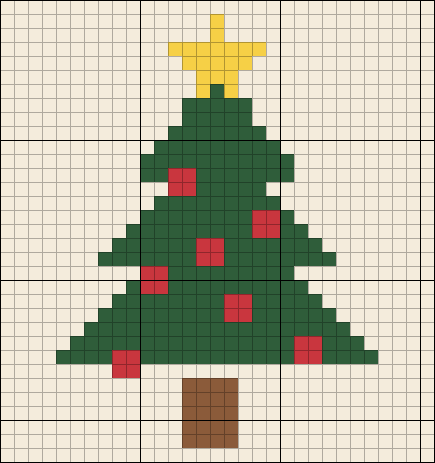
Thin lines mark every square, dark lines every 10 squares. Row 1 is the bottom row.
2Colors and amounts
| Key | Yarn color | Squares | Share |
|---|---|---|---|
| A | Cream | 742 | 73% |
| B | Forest green | 214 | 21% |
| C | Brown | 20 | 2% |
| D | Yellow | 19 | 2% |
| E | Red | 28 | 3% |
This chart uses cream (742 squares), forest green (214 squares), red (28 squares), brown (20 squares), yellow (19 squares). Worked in C2C it takes 63 diagonal rows, the widest with 31 tiles. In tapestry it is 33 rows of 31 stitches, with 2.7 color changes per row on average and 6 at most, with no single squares of a color on their own.
Squares are C2C tiles or tapestry stitches. To estimate yarn, crochet a few squares, measure the yarn used per square, and multiply by the counts above, or use the yarn calculator with a swatch.
3Finished size
Enter your square size
4Written rows
Tick each row as you finish it; your place is saved on this device.
How to read this chart
C2C: start in the bottom-right corner; each square is one tile. Odd rows are listed from the lower-left end of the diagonal to the upper-right end, even rows the other way, matching how you turn the work. Tapestry: each square is one stitch; row 1 is the bottom row, read right to left, and the next row left to right. The letters match the color key above. More detail in the graph maker, which uses the same rules.